Make America Hate Again Thy Art
There are footling decisions to brand in life like what to wear to work and what to eat for tiffin. Then there are potentially life-irresolute decisions like whether to motility, accept a new job, break up with someone, or get married. With these large decisions, you may never have faced that choice before, have to sacrifice one path to choose another, and have a hard fourth dimension figuring out the correct way to go. As a event of the high stakes and loftier uncertainty, we oftentimes flounder in this kind of controlling, sometimes failing to make whatever decision at all.
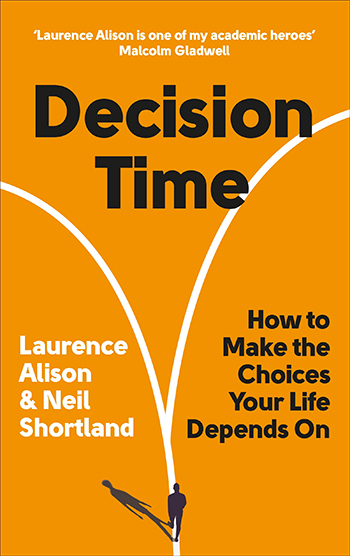
My guests have studied those who accept to make these kinds of critical choices more than oft — first responders and members of the military — to effigy out how civilians can make better decisions in their everyday lives. Their names are Laurence Alison and Neil Shortland, and they're the authors of Conclusion Fourth dimension: How to Make the Choices Your Life Depends On. Today on the prove, Laurence and Neil explicate the mistakes people commonly fall into when making big decisions, including getting stuck in a cycle of redundant deliberation, where you forever circle around your options without e'er pulling the trigger on one. They and so unpack their model for more effective decision-making, including why information technology should follow a foxtrot pattern, and how to know when it's time to finish ruminating and finally make a option. Forth the manner, we discuss the importance of cocky-awareness in this process, and what it is you demand to know well-nigh yourself to brand improve decisions.
Resources Related to the Podcast
- Conflict — How Soldiers Make Impossible Decisions by Neil and Laurence
- AoM Podcast #648 with Laurence on building rapport
- AoM Podcast #744 with Laurence on life lessons from the labors of Hercules
- AoM Podcast #486: How to Get Better at Making Life-Changing Decisions
- AoM Podcast #740: Life'southward ten Biggest Decisions
- AoM Podcast #685: How to Make up one's mind
- AoM #644: How to Develop Greater Self-Awareness
- AoM Article: How to Wrestle with a Difficult Decision: Advice from Sergeant Alvin C. York
- Written report on "inappropropriate persistence"
- Maximizers vs. Satisficers/Minimizers
Connect With Laurence and Neil
- Ground Truth Website
Heed to the Podcast! (And don't forget to leave us a review!)





Listen to the episode on a separate page.
Download this episode.
Subscribe to the podcast in the media player of your selection.
Listen ad-free on Stitcher Premium; get a gratuitous month when you use lawmaking "manliness" at checkout.
Podcast Sponsors
Click here to see a full list of our podcast sponsors.
Read the Transcript!
If you appreciate the full text transcript, please consider altruistic to AoM. It volition aid cover the costs of transcription and allow others to enjoy information technology besides. Cheers!
Brett McKay: Brett McKay here, and welcome to some other edition of The Fine art of Manliness podcast. Now there are footling decisions to make in life like what to vesture to work and desire to swallow for lunch. And so there are potentially life-irresolute decisions like whether to motility, take a new job, interruption upwards with someone or get married. With these large decisions, y'all may never face the choice before, have to sacrifice one path to choose some other and accept a hard time figuring out the right fashion to go. Every bit a result of the high stakes and high dubiety, we oftentimes flounder in this kind of controlling, sometimes failing to make any decision at all. My guest has studied those who have to make these kinds of critical choices more often, first responders and members of the military, to figure out how civilians can make meliorate decisions in their everyday lives. Their names are Lawrence Allison and Neil Shortland and they're the authors of Conclusion Fourth dimension: How to Make the Choices Your Life Depends On. Today on the prove, Lawrence and Neil explain the mistakes people ordinarily fall into when making large decisions, including getting stuck in a cycle of redundant deliberation where you forever circumvolve around the options without ever pulling the trigger on i. They then impact their model for more effective decision-making, including why you should follow a foxtrot design and how to know when it's time to cease ruminating and finally make a choice.
Forth the way, we discussed the importance of cocky-awareness in the process and what it is you lot need to know about yourself to make improve decisions. After the bear witness'due south over, check out our bear witness notes @aom.is/decisiontime. Alright. Well, Lawrence Allison, welcome back to the testify. Neil Shortland, welcome to the prove.
Neil Shortland: Give thanks you lot for having me.
Lawrence Allison: Thank you for having us again.
Brett McKay: Lawrence, we've had you on the podcast in the past to discuss two very different topics. The kickoff time nosotros had y'all on, nosotros discussed what you've learned about building social Rapport from existence an adept in criminal interrogation, and and then the second time we talked about what we tin larn about life from the Mythical Labors of Hercules. Y'all got a new volume out that you've co-authored with Niel, information technology's called Decision Fourth dimension; information technology's all about conclusion making. So let's start off with a chip of your corresponding backgrounds. Let's start with you Lawrence, some listeners may already exist familiar with you, but tin y'all give us a little bit of review on your background, and then Neil, what'southward your background? And how did you two air current up working together on this volume?
Lawrence Allison: Yeah, so I'1000 a psychologist, broadly speaking, a forensic, but also do a lot of organizational psychology, as you said Brett, you lot very kindly had united states of america on before to talk almost Rapport, and my other area of interest is controlling. So I mean, in brief, I deal with things that include difficult advice and hard decisions, been doing that for the last xxx years, and that's me.
Brett McKay: Neil.
Neil Shortland: Give thanks you lot. And then non to age Lawrence, but I was actually a student of his in 2011, on the master'due south program in Liverpool, in which I was briefly introduced to some of the research and the ideas around how, I think, real people make decisions in the real world, and then for me, I actually ended up moving off and working with the UK Military and so moving to America and studying kind of security psychology. But throughout all of information technology, I kind of kept this real interest in a newspaper Lawrence wrote in 2012 about kind of what police force decision-making looked like in these kind of fast-moving, counter-terrorism operations. So I went back to Lawrence a couple of years later and kinda had this idea of, what if we expect at this farthermost decision-making psychology, but allow's add in this kind of military interest and angle that I kind of picked up forth the style?
Then for that, I think five or six years we kind of worked with the army over here and the regular army in the Great britain and lots of different agencies studying the real human process of making actually difficult, high doubt decisions. And so I think kind of seeing the positive outputs of Lawrence writing Rapport and a volume really aimed at the general population and translating our kind of psychology for a much larger audience, we had a thought that a really dainty thought would be to do the same affair with decision-making, 'cause the more you talk nearly studying decision-making with everyone in your life, the more than they tell you lot they really need help making decisions and they wish they understood their ain decisions. And then that kind of brought us, I recollect, to the signal of writing Decision Time, which was this translational piece of all of these soldiers and police and fire and all these difficult decisions we have studied and trying to utilize that to aid people in their everyday lives with the decisions that they focus on and struggle with.
Brett McKay: Okay. So this blazon of decisions you lot're focusing on this book are not everyday decisions, they're not like, what am I gonna have for lunch? Every bit you said, Neil, these are farthermost decisions, like 1% of decisions people have to brand. In the military, in the constabulary, I can see the type of things that people would have to make a determination, whether to engage with an enemy, shoot, not shoot. For an average person, what kind of decisions, extreme decisions does a regular person have to confront?
Lawrence Allison: There's lots of books most decision-making and how to improve your life, but as Neil said, we've been dealing, in my case, for the last 30 years, with people that make life-changing decisions. And although that is within military, security services, law-enforcement then on, nonetheless, we often find ourselves at a crossroads where nosotros're making a really hard life-changing conclusion and it could be something every bit benign as, what business firm volition I buy? But that said, sometimes these decisions are really, actually important and are really difficult, that might exist to practise with whether to take cancer treatment or an end of life decision or something that is heavier, that is consequential, that is not reversible, that is high stakes, that does carry dubiety and does carry gamble. So they're the, I guess, less than 1% of decisions that we might face only that are going to change our lives. And that's why nosotros wrote the book.
Brett McKay: Yeah. And so okay, the stakes are high, a lot of incertitude and other characteristics of the decisions, frequently times you only have to brand that decision one time in your entire life, and so you don't accept whatsoever patterns to look back on on how to make the decision, 'cause you haven't faced it before and you probably never volition again.
Neil Shortland: I think 1 of the things that I'd add is, so from… When we were doing the original work with the soldiers, I think talking to a VA clinician about the kind of decisions that we were specifically focusing on. And the way she phrased them, which I always really liked was she called them kind of 'Shoulda, woulda, coulda' decisions, and what made these decisions that we studied then tricky was that, when the people made the decision, you lot could realistically see that both options could be good and both options could exist bad. And very few decisions actually truly nowadays in that way and information technology makes them very difficult to brand, because fifty-fifty if you choose path A, information technology's very like shooting fish in a barrel to convince yourself that path B as well could've been equally good. And I think when we look at our everyday decision-making and the decisions we make in our life, it'due south not every decision that presents itself that fashion, but there are, as Lawrence said, these life-changing, path-changing decisions we all face perchance around taking a job, maybe effectually ending a relationship, maybe effectually moving country for love or career or whatever it may be, and if it'southward those decisions that both options could exist really skillful or could be really bad, you've never had to make that calculation or that decision earlier and there is that high uncertainty.
Again, we've all experienced that, just as Lawrence said, information technology's a rarer form of decision, just the impact and potential of these decisions is and then, so much higher. And then the other thing that makes selection and then difficult, and from a psychological standpoint, is in order to cull i cause of action, you necessarily have to sacrifice what the other form of action is offering you, and very few forms of decisions brand you have to exercise that. Again, it'south a specific class of decision-making, only it is psychologically, I recall the most difficult because you have to sacrifice, you accept to argue to yourself and yous're starting from a place of really not knowing whether A or B is the right pick or the right outcome for you.
Lawrence Allison: Just to follow up on Neil's thing, just by mode of giving an example, nosotros talk near in the book, nosotros compare, which might be a weird comparison, but we talk about the Thai cavern rescue where, what Neal was proverb is, if yous take 1 course of action and you send a SEAL in to go and save the kids, once you've committed to that course of action, it could go incorrect, but you're not gonna know whether that goes wrong until you commit. And in the same fashion, it might seem a ridiculous comparing, but if y'all've been in a relationship for many, many years and you make up one's mind to end that relationship, you lot can't then not end it, y'all can't have both pathways, you tin can't have your cake and eat it.
Once you lot've made that commitment, those decisions that are irreversible are specially difficult because you lot can't play at that parallel universe version of that decision that y'all didn't make or that choice that you didn't take and meet whether information technology would have been better or worse and that is what oftentimes causes hesitation. So one of the other things I wanna emphasize is this, that often it's important to commit to what information technology is that you're gonna do considering a lot of people spend their lives waiting and thinking merely not acting. Then the other affair that this volume touches on quite a lot is this thorny problem that we've seen a lot in emergency services, law enforcement and and then on, that they're not actually making erroneous decisions, they are declining to commit to a course of action. And y'all see this fourth dimension and time again, whether it'southward a terrorist event or a disaster management thing, organizations are often criticized for being tedious to act or not acting at all, rather than making a actually catastrophically bad decision. It's about pace, timing and accurateness.
Brett McKay: Yeah, I wanna dig more into decision hesitation, decision inertia, 'cause I thought that was really interesting. But before we do, in your feel, when you've looked at the research literature and also but in your own experience, when an arrangement or an individual faces 1 of these extreme decisions where information technology's super uncertain, you simply have to get in in one case, the stakes are high, what'south the typical conclusion design or method that people fall back on to, and why practise they fall brusque?
Lawrence Allison: Well, we've washed quite a lot of work on the difference between novices and elite performers in this regard, and in that location are basically four mistakes that novices make that elite performers don't. The first… And actually, all of these things are nearly proportionality and moderation. It'southward a flake similar the Rapport book where we're talking about anything that's extreme is unremarkably bad, it'due south the aforementioned kind of principle here. And what we know that our elite performers practice are, outset of all, when they are trying to weigh up what it is they are dealing with and diagnose the bodily problem itself, they will develop ii or three plausible explanations for what'southward going on.
Novices either develop one and stick to it and confirm everything in that i management, or they develop a huge proliferation of possibilities and they can't juggle them in their mind. And then proportionate development of iii or four options to explicate what's going on and and so digging into them to decide which best accounts for the situation, that's the first affair. The 2nd matter is fourth dimension direction. Our elite performers are neither too slow nor too quick. They know they need to ask about fourth dimension or consider time as a factor that they demand to consider, and if they think that the window of opportunity is collapsing speedily, they volition get with the all-time selection that they tin can given that time constraint. They also are able to [0:11:23.viii] ____ if they do take more than time and if you do, you lot should employ it. If you've got more time to house up the state of affairs, you should use it.
Novices either human activity also quickly or too slowly and often don't ask about time at all. The tertiary matter is that our experts are able to adapt, and then novices suffer from what we telephone call entrainment. They will develop an thought, they will stick with that idea, and even in the face of compelling prove that suggest they should change tact, they don't. Our experts are able to recognize and respond to those cues apace and change accordingly. And then the fourth affair is the power to revise the programme, the power to throw out the plan that was developed, that was correct for then, but isn't right for now. So those are the four sort of mistakes people make. Besides much faffing around trying to effigy it out, not because time at all or just pondering forever, failing to conform to the new circumstances and being unprepared to revise. Our elite performers don't practise that, but I've got to say, our elite performers are rare, why? Because if this is 1% of the times that you have to make a determination, as Neil said, y'all don't have that dictionary of feel behind y'all to be used to dealing with these novel or unique events.
Brett McKay: Yep, and I think most people, what they do when they face a tough conclusion, at least this is my method, is I'll become online and encounter, "Well, did someone else have this problem?" And see how they fabricated the determination. But information technology's kind of useful, but in the end it'due south not… I commonly find it not very useful because that person's state of affairs is so unique that it's like, "Well, okay, this doesn't apply to me. I don't… I tin't exercise anything with this."
Neil Shortland: Well, I think that's a… It's a really expert point and it'south an interesting method, Brett, and I think information technology links to I think one of the points that nosotros'll hopefully talk about throughout the interview. But 1 of the big things we emphasize about these forms of decisions is that they are often deeply personal, as in what the right conclusion is varies based on who the decision maker is.
Then to give you an example, when we were writing the book, it was kind of at the starting time of the COVID-19 pandemic, and ane of the things that a lot of people were talking about was how immature couples were handling the decision to get married or not go married or delay or do information technology by Zoom and all of these kind of things. And looking at that determination, I think you could always… You could await at what other people were doing, you could look at were they doing it via Zoom, you could await at whether they were delaying iii years, five years, 10 years, whatever it was. Merely to make that determination correctly, really information technology's but… What matters is what is correct for you in that moment and that'southward one of the things I think the book actually emphasizes on, is that it is always adept to look at other people and call back almost maybe what other people take done, but at the end of the day, what we preach is this idea of know thyself, and so it really comes down to, I call up what makes y'all be able to make that determination is being able to look inside of yourself and know what truly matters to you lot, 'crusade information technology may be different to what these other people have done and how other people in the past take made that conclusion in that moment.
Brett McKay: Well, let's circle back to this idea of determination inertia, why is information technology when we face up these big decisions with high stakes, lots of uncertainty that nosotros typically don't exercise anything? Similar what's going on cognitively to cause that?
Lawrence Allison: Well, what people tend to do is they go through a process that we call redundant deliberation. Information technology'south really weird actually considering it's using a lot of cognitive effort for no proceeds. They volition think almost pick B and recollect about all the permutations for option B, they would think nearly selection A and all the permutations for pick A, and they volition just not be able to determine betwixt the two, 'cause they don't want to commit, they don't want to terminate that relationship, they don't want to have that kind of treatment because non having it could be ameliorate or staying with the same person could be improve, and then the sort of in perpetuity merely keeps circling around and around these plausible options. So my view that I used myself, ii things that I enquire myself that I think are useful when you're faced with these are, ane, do I accept to determine at present? You need to understand whether that decision is fast-paced or slow-paced, and if it's fast-paced, maybe y'all need to make a decision at present. But nigh decisions aren't super fast, and so therefore you lot do need to slow things downward and seek more information, but you tin't put an infinite timeline on it, you take to put something that'south proportional.
The second matter I always ask myself is this, what is the goal? What do I desire this to end up looking like? And we've found it with police before or even but every twenty-four hours decisions, people get fixated on the decision, but not the ending betoken, not the goal. What is information technology ultimately that you lot want out of this? And Neil, I don't know if you wanna talk about your own personal experience with your wedding, 'cause I know we went through it ourselves, just there was a lot of debate. But when yous articulated what the goal was, the decision presented itself easily, and then I don't know if yous wanna give that example.
Neil Shortland: Well, I tin can 'cause I call up it'due south interesting. So when we call up about indecision, and I call back one of the actually interesting things about Lawrence's work historically on this and some of the things that we brought into the book is, psychology is kind of the emphasis on stimulus response and most of psychological enquiry is set to force the person to choose something and appraise the option that they made. And so the idea of, I guess studying the absenteeism of a choice is actually quite psychologically odd, but one of the things that nosotros encounter is it'due south really, really pervasive, and you see it in everyday life, and in that location are different ways that people try and avert decisions, from avoiding it completely to knowing what they desire, but never, equally Lawrence mentioned earlier, never actually beliefs really committing to information technology. And it's a really easy design to fall into.
And when I think about your question, Brett, what… How do nosotros kind of overcome it and what does it… What kind of causes it? The thing that I always come back to, I think is fearfulness encouraged being essential here. Because when you look at a true… A truthful difficult decision, so what we would call a least worst decision that we kind of talk about in the volume, so all the examples we gave earlier, leaving relationships, changing jobs, moving countries, divorces, how to have a marriage, all this kind of stuff, choosing something and committing to a grade of activeness requires swell backbone because you know that in doing then, yous're actively losing something by choosing the choice that you've made. So I will give the example that Lawrence gave that I think a lot of immature couples faced in 2020. So I was with my now married woman, Spoiler, I estimate to the conclusion nosotros made, but we had that horrible decision in May of 2020, of do we get married via Zoom or some course of stripped down COVID wedding, or practice we delay and have the large 100-person, 150-person nuptials that we'd spend two years planning. And we concluded up choosing to go married via Zoom.
And why I say that backbone is so of import is that when we made that selection, and then you lot know, we knew that nosotros were gonna do it on the original date, just a few people, completely socially distant, with no family coming, no friends flying over. Nosotros knew that it was going to hurt and you know that it is a difficult decision, and even though you know that you've called the correct thing, yous still accept to have backbone because y'all know that you've sacrificed things that are really, really important to you. And I call back that's what really difficult choices require of you, they really crave courage 'cause you know that even if you think or know you're choosing something that's right, you're nevertheless losing something that mattered to yous, and that's why these decisions are so difficult. And then I recollect when it comes to this idea of overcoming inertia, of committing to decisions and making them in the real world…
One of the things that Lawrence and I talk about a lot in the volume is just the value of courage, and that's because fearfulness of loss is such an innate homo thing, we are designed to protect our resources, nosotros hate the thought of loss. Merely a choice requires you lot to embrace loss and stare loss in the face because whatever y'all practise, whatever you choose, you will have to lose something, you will take to cede something. And and so it'due south this real balance, I think, of being brave enough to tolerate the loss in the noesis that y'all are embracing the greater good or embracing the right choice for the correct reasons.
Brett McKay: My ain feel, the thing that causes me to put off decisions is that rumination trap that Lawrence was talking almost, and like you said, it's really sneaky because it feels like you're doing something, It's like, I'm really thinking most this, just you're just going in circles just over and over over again. Yous accept to decide, "I gotta make a decision, this is not doing anything," you have to catch yourself doing it and then just make the decision and move forward.
Neil Shortland: It's kind of nigh this curve of diminishing returns, and so nosotros've planned a study recently where nosotros kind of… We go people to make a series of decisions, and yous tin can give… Nosotros ask them if they desire more information, in that location are well-nigh five unlike information injects. And what's really interesting is some people will say they want no information whatsoever and they just swoop right in and that's not skillful, and then some people want all of the information and eventually you accept to kind of say, in that location's no more data, just come up on, come on and exercise the decision. And the Goldilocks in this is someone kind of in the centre who takes some early information and really helps themselves understand the situation, invest a lilliputian flake of fourth dimension early on, but and so knows that anything more than that they're getting out isn't really helping them, and now is the fourth dimension to only kind of go out of that redundant deliberation and only move on to the making of the determination. And it'southward something interesting. And Lawrence, you lot might wanna talk about this from some of the work that we've washed together, just nosotros kind of identified this interesting Play tricks-Trot design that some of our meliorate decisions makers engaged in, which is where they were, I think…
What is it like? Slow, slow, quick, quick. My dancing knowledge might be a little off.
Lawrence Allison: Yes, tedious, slow, quick, quick. Slow, wearisome, quick, quick, dull, actually.
Neil Shortland: Okay. And so what this was is we were doing a report with armed forces or police, I think information technology was, and looking at the dissimilar patterns that people utilize to make decisions, and what we found was there was this one design that people engaged in, which was kind of fast, fast, slow, slow, which was that they moved through the data gathering stage really, really chop-chop, simply then they got really stuck on the actual process of having to choose betwixt the options, and then there was this kind of more… I think information technology was the more than senior officers who really demonstrated this pattern, which was kind of this idea of the deadening, slow, quick, quick, which was that they took more time to gather the information, they took a bit more time to comprehend the state of affairs, and then when information technology came to making the decision, they were much faster to be able to choose what the right option to them was.
Brett McKay: We're gonna take a quick break for a word from our sponsors. And now dorsum to the show. You devote a chapter and you mentioned it early on on about, if you wanna brand better decisions, you have to know thyself. How does greater self-awareness meliorate controlling? What practice we need to know almost ourself in club to make improve decisions?
Lawrence Allison: Well certainly, one of the things that we're repeatedly finding is that in that location'southward this aspect called maximization or minimization, which in really elementary terms is, if yous tend to exist a maximizer, you're the sort of person that wants everything to work out really well, and so you discover information technology very hard to tolerate a poor upshot or fifty-fifty an upshot where there'south two options, both of them await bad and you're not really prepared to fifty-fifty pick the least bad 1, so in that location'southward really bad and bad, but you just don't desire the bad 1. And people that are maximizers, we tend to find, suffer more than from this kind of redundant deliberation or constant rumination considering they're thinking… Basically feeling regretful about a future scenario that they detect intolerable. Whereas, minimizers, which is the kind of alternative sort of thinking arroyo is, okay, this is not ideal, but I'd rather take this least bad option than the really bad 1. And so function of this is knowing whether you're a minimizer or a maximizer, and they're not necessarily one better than the other, but if y'all score very high on maximization, you tend to be the sort of person that volition ruminate in perpetuity.
So that's 1 function. The other thing that nosotros know quite a lot most is this affair chosen need for closure, and in simple terms the idea of that is if you are the sort of person that requires a lot of predictability, certainty, order, decisiveness, you wanna know exactly what time you're gonna meet at the eating house, how many people are gonna be there, what's gonna be on the menu, dadadada, that type of affair can slow people down also, so people that tin can tolerate ambiguity, which is the contrary of need for closure, tend to be faster time decision makers. So the wide concept virtually knowing yourself, and I call up Neil spoke nearly this before, is knowing what your value system is, where you wanna stack your tokens, what matters to you most and having good insight into that and being able to clear that and face up yourself in the mirror and think near it will help you lot identify the absolute critical function of controlling, which is, what is my goal? Where do I wanna end up? What am I prepared to sacrifice and what I'thousand not, and Neil did a lot of work on what we phone call sacred and secular values, so just a little segue on that. Where you have a sacred value, it's something which is non-negotiable. So if nosotros talk virtually armed services sacred value, you might take a sacred value of, "Leave no man behind."
A secular value is something that you'd like to retain but isn't critical and might be negotiable, simply where you accept a trouble is where two sacred values collide. So in military ops, what we institute that if you've got the sacred value of leave no man behind and complete the mission, and we design a scenario which has both of those colliding, that'south where you notice it difficult to tease those ii things autonomously. Then sacred values are the ones that are really catchy to negotiate. 1 other matter I just wanna add about a Fox-Trot thinking, which I retrieve is interesting, and to just reinforce this point for listeners, stacking your tokens at the front cease of the thinking is a good thought. To remember almost what it is that you lot are dealing with advisedly and diagnose what you're dealing with is really important, that and then enables you to speed up.
Brett McKay: Well, yeah. Lawrence, we talked near the sacred/secular problem in our chat near Hercules facing decisions. Nosotros had sacred values in conflict with each other and information technology made decisions tough.
Lawrence Allison: Yes, yeah. Without segueing into the Hercules thing, we had that verbal situation, didn't we? Where he'd left one of his compadres behind subsequently a scrap and that was a difficult thing to exercise. Information technology kind of ruined him and created a degree of moral injury, and that's not uncommon in soldier scenarios. Just Neil may accept something to say nearly this likewise.
Neil Shortland: Well, no. I recollect it's all tethered to the idea of kind of knowing thyself. And and then the one matter that I've heard, nigh of the feedback I've had from the book from family member and friends is they call me and they say, "Oh, you wouldn't believe it, I'thousand a maximizer." And I'one thousand like, "Well, yes, considerately, I probably could have told you that." And they ever say, "Well, it's a bad thing" and I ever say, "Information technology'due south not a bad thing, beingness a maximizer isn't a bad affair. But knowing yourself means that y'all know what your miss is going to be." And and so what we talk nigh in the decision making is that there are times to be a maximizer and there are times when y'all actually can't maximize. And what you wanna avoid is the endeavour to maximize in a not or un-maximizable situation.
And I recall it's really kind of ane of the important things that knowing thyself means, is you know the design you lot're gonna fall into, you know what your personality trait is and what you're going to want from a determination. And sometimes it's most knowing that the decision that you're facing merely isn't gonna let y'all have everything and accepting that and beingness able to move on. And I call back that links to what Lawrence was but saying, is kind of the second part of knowing thyself, which is literally about knowing thy values. And one of the formative books as nosotros were writing the original book, we wrote a book called Conflict: How Soldiers Make Impossible Decisions, which kind of was our platform for writing Decision Time, was Mark Manson's book, The Subtle Art. Basically the art to a happy life, or the fine art to happy living is knowing the ane matter that you intendance nearly and then much that you're willing to sacrifice everything else.
And that has always been our kind of framework of knowing thyself and this give-and-take of sacred values, is looking at a decision and knowing the one value, if yous can, the one value that admittedly matters more to y'all than anything else. And it'due south really difficult to practise. And nosotros give examples in the book from people that we've met and people that we've worked with. And we have friends who we've watched face up these kind of decisions. You're given this brand new promotion or this brand new job opportunity, and information technology's actually important to you that y'all chase your career and you have value in your work and you lot achieve everything you can, merely that's running directly against something else that might exist investment in the family and spending time with your immature children and your wife as they grow upwards and they do these foundational moments of taking their first steps, saying their first words.
And what a practiced determination maker has to be able to do is to sit there and work out, "I have two values going confronting each other and whatever choice I make I'grand going to run over one of those values, so which one can I absolutely not cede in whatsoever way? Is it myself, my career, my conviction and my identity? Or is information technology me equally a family member, me as a father, me contributing to the household? And if people aren't able to know thyself and know that value and links back to the Heracles example that Lawrence gave in your prior podcast of, you really risk this idea of moral injuries. When y'all make a decision that sacrifices something that'southward truly, truly of import to yous, that'south a specific course of trauma that you can have from making the wrong decision in a crucial moment. So all of our model of decision-making, it's all based on first and foremost knowing who you are, knowing your patterns and your tendencies and your psychology and then knowing, really being able to work out what actually matters to you when it comes to making this decision, whether it'southward the gold or the values.
Brett McKay: Well, allow's move on and talk about your decision making model and it's called STAR, it's an acronym, and the S in STAR stands for situational awareness or storytelling. What'due south involved in developing practiced situational awareness? Any questions people should be request when they face a conclusion and they're trying to get their bearings on the situation?
Neil Shortland: So when it comes to situational awareness, I guess there are kind of… The original model is that there are kind of three stages of situational awareness, which is kind of identifying the patterns in the surround or cues in the environment that thing, webbing them together to get kind of get an understanding of what'south going on, and and so this third layer is kind of using that to project what will happen if you practice action A or do action B. And every bit Lawrence kinda mentioned earlier, the matter about situational awareness is it's about not simply going all in, originally just going all in on this one assessment of the situation, having adaptability and the flexibility to call back about, what are the other factors that could be going on? What are the unlike interpretations of this state of affairs? And we talk well-nigh in the volume, one of these early on trainings that Lawrence gave, and I think at the time I was kind of helping aslope.
But we gave this early on training to police officers, kind of policing the tube during the, I think it was 2012 or 2014 Olympics in London, and what nosotros talked to them about was this idea of, when you lot're stressed, when you're tired, when you're hot, when y'all've got all of these things going on, you're running out of resources and the natural design is to think you know what'southward going on, to non test it, to not remember of alternatives, and simply to basically but go all in on this one assessment of the situation. And I think kind of in the S model of our STAR, what we really preach well-nigh is being open and flexible to thinking or holding in your listen, are there two or 3 potential explanations for this situation? Potential interpretations of what I'yard seeing in front of me and what this means. And the farthermost of that is something that Lawrence and I accept talked nearly and we recently put a paper out, about, the all-time conclusion makers are, when they have to be they're kind of grim storytellers, they have imagination, they're really able to think critically about what their situation is.
And and so with the Southward stage of the model, it'south finding a calibration between these ii extremes that Lawrence mentioned earlier, correct. The get-go is just… The outset extreme is simply seeing something thinking y'all know exactly what'due south going on and diving right in with this kind of singular estimation of the situation; This has happened and I think it'south gonna be this. On the very, very other cease, is non really knowing or committing to whatsoever kind of interpretation and just thinking that, well, at that place are 100 things that could explain this and I can't really move forward because I don't really know possibly anything that's going on in this situation. And in the middle, there'south this kind of sweet spot of being able to place a few plausible explanations and taking the time to kind of game those explanations confronting each other to actually get the all-time understanding of the situation that you tin. Because everything most a decision stems from what you actually think is going on and how you're interpreting kind of the data that'due south in front of you.
Lawrence Allison: The key takeaways from that, I think, are, don't over-ruminate about every possibility. Conjure in your caput two or 3 possibilities and make certain that ane of them, which I know is a flake unpleasant, but i of them should be, what's the worst instance scenario here? What is the… If I call up this is going on, okay, I don't actually wanna get at that place and call up information technology's maybe this bad, but, you know what? Maybe I do need to remember it's mayhap this bad, because so the shock of it being that reality is less damning and you are prepared to deal with it. And then simple takeaways, think about what it is you're dealing with, accept no more three, that's a bit of a rule of thumb, but information technology's difficult to take in your mind more kind of 3 possible situational models almost what you're dealing with. Make certain one of them is the worst possible scenario.
Brett McKay: Okay. And what'due south interesting is that all this, you lot don't… You're admitting that you don't know what the situation is exactly 'cause you have three different options.
Lawrence Allison: Yeah, so you are alive to the possibility that in that location are three means to explain what information technology is that you're seeing. Then say you wanna cease a relationship or… I recall we talk almost a mastectomy there, whether you're gonna accept your chest removed in relation to cancer; you wanna sort of remember virtually, what does this look similar? What's the worst case scenario? Or what do I value? Maybe this could happen, this could happen and this could happen. Three options. Best case scenario, worst example scenario, somewhere in between, but don't ruminate on that forever. At that point, it gives you some kind of idea about how much… What piece of work yous need to exercise to disentangle whether it'due south more probable to exist one, two or three in the same way that perhaps someone that'south dealing with an illness is gonna be looking at information technology. Someone comes to the md and they present with various symptoms, that medico should be thinking, "Well, this could be this bad, it could be cancer and therefore what practice we need to practise to house upward whether it is. What tests practice we need to do that?" Even so, it could exist something benign and that'south a plausible scenario as well, and it's to that stage that you should seek to interrogate information that will help you lot push button forrad ane of those three scenarios more than than the other.
But like I say, when y'all're considering these existential pathways, you do have to contemplate the worst case scenario. It gives you much more stretch in your imagination to be able to bargain with what is gonna eventually be coming at you.
Brett McKay: Alright, so the next office of the Star Model, T stands for time mastery. Why is when we brand a decision important and then what happens if your timing is off?
Lawrence Allison: Because if it'southward imminent and the decisions movement past you, y'all're not good basically. It does surprise me how oft people don't even consider time. Our really poor decision-makers don't even enquire almost it, they don't think, "Exercise I have to make up one's mind now, how much fourth dimension have I got?" They just think they've got all the time in the earth. And for about of us, near of the time, happily, nosotros practice accept a flake of time to think about our decision. In military situations that isn't always the case, but sometimes even in our ain lives in that location is a time limit on which we should really… I mean, I've spoken to countless people, police officers that have stayed in the same job for years, and every year they're saying, I kind of feel a bit burnt out with this job and mayhap I should change and I'g non giving enough fourth dimension to my family unit, what do you call up? And and then we'll go through all the possible scenarios that they could do and peradventure they could change this or they could modify to another unit of measurement, and then they'll come up back a calendar month later on, aforementioned thing and again and over again and again. And if you don't take that externally imposed fourth dimension pressure level on yous, with a shoot, no-shoot decision, you lot can just proceed extending that deadline forever.
So inquire, "Exercise I take to make up one's mind now." More ofttimes than not yous don't have to decide imminently, but if you don't have to decide imminently, then y'all demand to kickoff thinking about, what is a reasonable amount of time to allocate to this determination. And a pretty skilful tip to tell you that you have now run out of time is if you lot keep asking the same questions and you keep getting the same information, and then you actually don't wanna be waiting a lot longer because there is no new information and you do now need to make up one's mind.
Brett McKay: What happens if you have to make a determination now? Is there a heuristic that people tin use to know what'southward the right thing to do or the best thing to do in that situation?
Lawrence Allison: Very simple terms, least worst first. This is bad, this is atrocious, let's become with bad.
Neil Shortland: If there's a huge time pressure level and y'all absolutely take to make a decision right now and you honestly are staring at ii or iii horrible or bad options, the only thing to be able to do is really say to yourself, what is the one choice that I, or the one miss that I cannot tolerate? And that's that kind of that… If you tin do it, that's that kind of sacred value. And under time force per unit area, that may exist the simply thing y'all have fourth dimension to try and reverberate on or summate.
Brett McKay: Okay, and then the next role of STAR is A and that'southward accommodation. What exercise you guys mean by that?
Neil Shortland: Well, I call up adaptation'south a really critical stage, because I think when nosotros… It kind of links a little scrap to the offset phase, which is situational awareness. But in that location's some old psychology in kind of the 1990s on NASA, I think information technology'south NASA errors, and information technology constitute that most of the bad decisions or fault-based decisions in this airplane pilot sample was not because they didn't understand what was going on, it's because they understood what was going on, and so the surround changed and they were unable to update or re-evaluate what was going on when new information was coming in. And so I call back one of the things about… When we await at these decisions in the existent world and these complicated decisions that people are facing, they're iterative, they're moving moments in time. And so sometimes the scene does alter and sometimes the situation does change. And what we oftentimes see is that people fail to adapt and update their way of thinking And at that place's a lot of… I retrieve this links, probably the bespeak in the book that I recollect links to a lot of the cadre psychology around decision makers is driven past heuristics and biases and cognitive closure.
And the fact that the… Nosotros are cerebral misers in the sense that we're always trying to confirm what nosotros currently retrieve is right anyway considering it'southward easier than having to re-update and re-evaluate and reconsider what we think we're staring at. And then the accommodation stage is encouraging people that even if y'all've made the all-time assessment of the situation you lot can, and fifty-fifty if you have understood your relationship with fourth dimension and when a determination needs to be made, and assuming that you haven't missed the decision window, be open up to updating your assessment of what's going on. Be open up to new information. Be willing to ask if things on the ground take changed, if your current understanding is no longer in engagement and needs to exist updated. And it'south only an practise in almost practiced cognition.
Good cognitive healthy behavior to re-evaluate, re-update, reintegrate and just to cheque that what you lot call back is going on and assessed is going on is even so there. And it's actually difficult. So one of the examples we take in the volume is this interesting case of this guy, Jack, who's offered this chore out of the blue and information technology'southward kind of a shiny new task with a shiny new promotion. And if anyone's ever been offered a job or offered an opportunity, suddenly, the way you evaluate the electric current job, you're about looking for the negatives at present. Y'all've been offered this shiny new affair and it changes the fashion yous look at everything around you lot. And that'southward the brain, that's the mind trying to brand the decision easier by stripping away dubiousness and just closing itself off to any culling way of thinking.
Then when we make decisions our cognitive structure is sometimes working confronting us to make things simpler. And then adaptation in dynamic and difficult decisions is absolutely essential because people need to keep checking that their assumptions are correct, keep checking the situation is what they recall it is. Is in that location anything new? Is in that location anything different? Is there a chip of data that really needs me to think differently that something else is really going on here, that something has inverse since I started trying to work through this decision. And it's just one of those critical stages that we frequently don't run across and that old research has found it, our own research has plant information technology, that yeah, people really demand to focus on being adaptive and making certain that their cess is always in time with what they're facing.
Brett McKay: So the final office of STAR is R, and that stands for revision and resilience. And this tin be a actually hard part because often our tendencies… Subsequently we've made a decision, we've taken action and we're doing it, even though we get new data and we see, like, "Oh, we should probably conform," it's actually hard to go back on your decision. It'due south similar, "Well, I made a decision, I gotta stick with information technology." And then how exercise y'all effigy out whether or not you should stick with a determination or you should bond and modify your mind to do something else?
Neil Shortland: So it'southward a really interesting conundrum, and over again, I call back information technology speaks to just the mode… Just the ethos of the kind of psychology we talk about in the book. And Lawrence mentioned information technology earlier, I remember, "Nothing is good in extremes." And so in the resilience chapter and revision, nosotros really talk about this idea of alter in its extremes. And so 1 extreme of change is someone who, the minute they face a difficulty, the minute they face a hardship, abandons course and immediately goes to discover a new course of action and decides that their plan is a failure. And in psychology there's a lot of theories and inquiry on things like grit. And then Angela Duckworth, her idea of grit is this kind of… This aureate trait that predicts success is people's ability to be gritty and work through things. And we talk about desirable difficulties as existence able to work through hard moments. And difficult decisions oft require difficult moments.
And so the wedding instance I gave earlier, after making the conclusion, there were difficulties in telling people what your option is. There's difficulties, and if yous alter a job, it's not immediately astonishing sometimes. And in the starting time half-dozen to 12 months, there's difficulties. If you lot leave a relationship, there's difficulties, correct? And so there's this psychological idea that yous accept to piece of work through those and that'due south critical to success. And it is. And so on the other side, in that location's another organizational psychologist who kind of studied this thought of persistence and identified this really interesting function of persistence called inappropriate persistence, which is kind of this idea of just persisting for the sake of persisting because you just want to persist, right? Which is almost like the complete opposite end of the spectrum. And you lot're not persisting for a reason, you're not persisting for a purpose, you're merely persisting because you lot don't want to not persist at something.
And over again, that farthermost of non-revision is every bit detrimental and as harmful. If you lot change jobs and y'all move countries and two years in you hate information technology, and you still are unhappy and still nix is going correct, maybe that's a betoken to re-evaluating and coming dwelling house. And so it comes down to the question that y'all asked, which is how exercise you juggle and how do you know what the right residual of those two polar ends of the calibration are? And I think it comes back to in the way that we kind of talked about it in the book, is knowing why you're persisting, right. Then when you lot're experiencing a difficulty, a desirable difficulty or otherwise, why are you being gritty? What are yous persisting in purpose of or in the quest for? And I think information technology comes back to that idea of, are yous persisting for something that is sacred, that is important, that means something to you? Are you persisting in line with your values and your goals? And if you're non and you only detect yourself persisting because of a fear of non-persisting, well, and so yous may be in that state that you're no longer being driven past the correct motives and past the right motivations.
Brett McKay: Oh, so it all goes back to knowing thyself.
Neil Shortland: I recollect information technology really does, and I recollect the more that we talk about the book and the more than that we hear from the readers that have been very kind to share their thoughts on it with united states, that'due south what I remember it comes down to. One of the big parts, I think, when nosotros wrote it and what people are reading from it is the value of knowing thyself. And information technology's difficult because, I remember particularly if you lot're immature and you're thinking about your values. You know, values change, knowing yourself. The personality may be slightly more rigid, simply things that are sacred to you lot, that affair to you, that are actually important to you, they modify and it's most similar working out. It's something that you do need to consciously often remember most. Think nearly what matters to you, reflect on information technology, update what is actually sacred and important to me?
And Lawrence and I, nosotros had a long walk on the embankment a few weeks ago where nosotros talked almost our values and our goals. And it'south interesting that I've kind of… As I've grown upwardly, I'm experiencing sacred value shifts in real time. And you can't make a good determination unless you know what the most of import thing to you is, because the real take a chance hither… I think that one of the risks is not making a decision, merely the other risk is making a decision driven by a value that you think is the sacred 1 and finding out subsequently you've fabricated the determination that it actually isn't. And that's non a country, I call back, we'd wish on anyone and something that really this book is aimed at trying to aid people avoid. And so while I think the STAR model is critical because I think it really talks most what I call up real-life, difficult decisions look similar, we tin can't have away from just the importance of knowing who you are and what really matters to you when you're kind of looking at making these kind of fork-in-the-road, life-changing decisions.
Brett McKay: Well, Lawrence, Neil, information technology'south been a corking conversation. Where can people go to learn more about the book and your work?
Neil Shortland: The volume is currently available on amazon.co.uk and on Aural. And for any American listeners, I believe in about a few months it will exist out for the stateside audience. And whatsoever of our work on kind of the operational side of things, so training with constabulary, military machine, police force enforcement, we have our Ground Truth website, which Lawrence can right me if I go it wrong. Information technology's footing-truth.co.great britain, merely that's where nosotros kind of work with all of the practitioners on our decision-making trainings and our rapport trainings and any of that or our Twitter feed if you, I guess, wanna see our opinions on, well, current events.
Brett McKay: Fantastic. Well, Lawrence and Neil, thanks for your time. It'due south been a pleasance.
Neil Shortland: Give thanks you, Brett.
Lawrence Allison: Great to speak to y'all.
Brett McKay: My guests today were Lawrence Alison and Neil Shortland. They are the authors of the book, Decision Fourth dimension. It's available on amazon.com. Brand certain to bank check out our short notes at aom.is/decisiontime where you lot find links to resource and we delve deeper into this topic. Well, that wraps up some other edition of The AoM Podcast. Make sure to check out our website at artofmanliness.com where y'all can notice our podcast archives as well as thousands of manufactures written over the years about pretty much anything you'd call back of. And if you'd like to enjoy advertizing gratis episodes of The AoM Podcast, you can do so on Stitcher Premium. Head over to stitcherpremium.com, sign up, use code MANLINESS at checkout for a free month trial. In one case you're signed upwards, download the Stitcher app on Android IOS and you could showtime enjoying advertisement free episodes of the AoM podcast. And if you haven't done then already, I'd appreciate if yous take ane minute to give u.s.a. your review on our podcast or Stitcher. It helps out a lot. If you've done that already, thank you. Please consider sharing the show with a friend or family member who you lot'd recollect will get something out of it. As always, thanks for the continued support. Until side by side time, information technology'southward Brett McKay reminding you to not only listen to AoM podcast, simply put what you've heard into action.
Previous Next
weaverthatintopen.blogspot.com
Source: https://www.artofmanliness.com/character/advice/decision-time-podcast/

Postar um comentário for "Make America Hate Again Thy Art"